
March, 2026
Advance a Multi-Stakeholder Forest Corridor
Challenge
Although often referred to as the Bentarum corridor, or sometimes the Labian-Laboyan corridor because of its two rivers, connectivity throughout Bentarum has been reduced by a road that runs east to west through Bentarum’s central belt, linking the Kapuas Hulu capital Putussibau with Sarawak. The expansion of farms, industrial oil palm concession, dwellings, and business premises has further degraded connectivity.
Solution
Bring key landscape stakeholders together to create corridors that enhance forest connectivity and secure safe areas for wildlife across multi-use, disparate land-use types.
Progress
Sangga Bumi is securing a corridor that covers 107,765 -hectares, extending from Danau Sentarum in the south to Betung Kerihun in the north.
The corridor includes the following areas:
There is often a perception that forest corridors must secure complete, uninterrupted forest cover. We prioritise a more pragmatic approach, enhancing connectivity across land-use and habitat types but supporting sustainable development and how wildlife can travel safely in human-altered landscapes.
Through Hutan Adat and Hutan Desa management plans, we clarify how protected area should be managed. Through the process of developing village spatial plans, Hutan Adat and Hutan Desa can be integrated into areas used by villagers for farming and agroforestry. Our Sangga Farming approach is being applied with farmers to identify go/no-go areas for agricultural expansion and provide training on how to prevent negative interactions with wildlife. Through engagement with corporate concessions holders, it’s possible to advocate for the protection of forest buffer areas and the retention of connectivity between forest areas inside and outside of concessions.
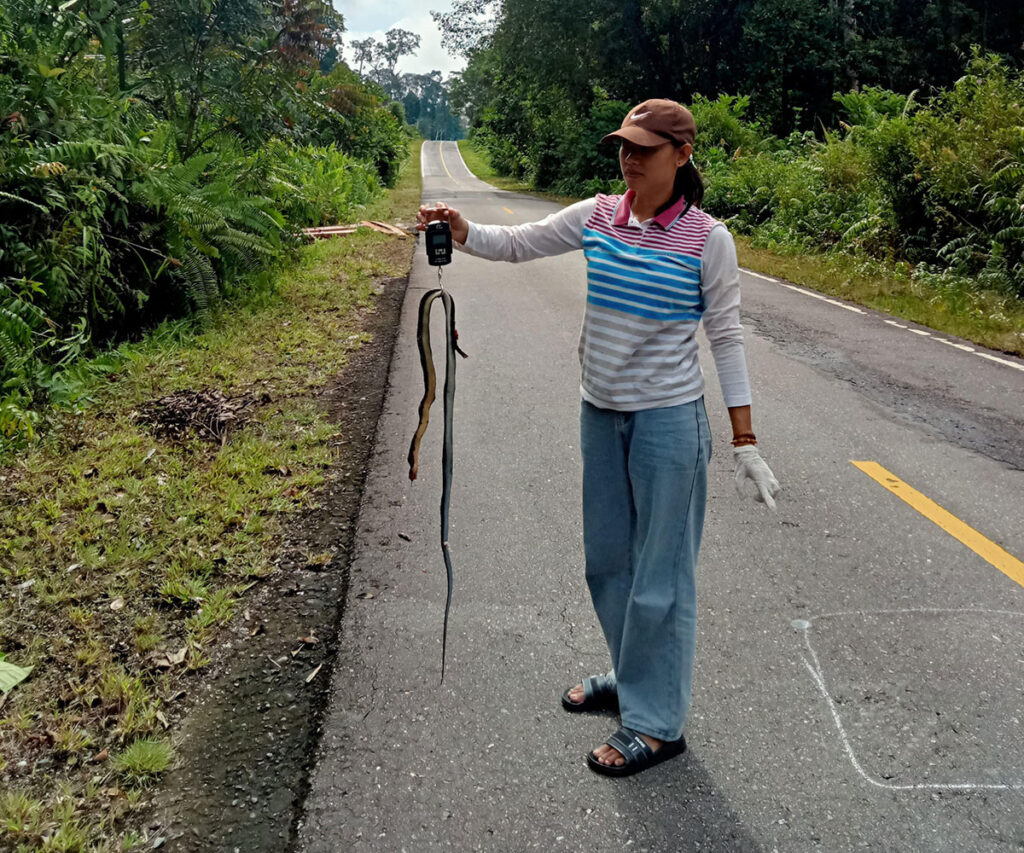
Sangga Bumi Lestari survey team conducting a roadkill impact assessment
Connectivity Challenges and Road Impact in Bentarum
The biggest challenge for connectivity in the corridor is the road that runs east to west through Bentarum. Between 2024 and 2025, we conducted a road impact study. The stretch of road that runs through our corridor has the highest traffic count but a lower roadkill count than other stretches of the road. Despite this, wildlife mortality is high. Almost 80% of residents have seen carcasses on the road, which tend to be snakes, chickens, rats, dogs, and birds. Large mammals appear to largely avoid the road. Species occupancy is high at distances of around 2-4 km from the road, but it reduces significantly at around 50 metres. This indicates that for large mammals, Bentarum has essentially become a separate northern and southern landscape, with little evident population connectivity.
Hunting is too high in Bentarum for wildlife bridges to be an immediate solution but the trialling of potential ways to regulate traffic flow and reduce collisions (for example rumble strips that give an audial warning) will be trialled between 2026 and 2028.